
Child Care Fraud Hurts Honest Providers: What Investigators Should Look For
- Quick Answer: Why Does Child Care Fraud Matter?
- Key Takeaways
- Nick Shirley Is Right to Ask Hard Questions
- Fraud Is Not a Victimless Crime
- Child Care Fraud Hurts Honest Providers
- Where Child Care Fraud Can Hide
- Child Care Subsidy Fraud: Why Attendance and Billing Matter
- Licensing Violations, Poor Operations, and Fraud Are Not Always the Same Thing
- What Investigators Should Understand About Childcare
- Questions Investigators Should Ask
- What Honest Providers Can Do to Protect Themselves
- How States and Agencies Can Strengthen Accountability
- A Message to Nick Shirley and Other Investigators
- A Note About Public Accusations
- How Child Care Biz Help Views This Issue
- How Childcare Owners Can Build Stronger Systems
- Final Thought: Root Out Fraud and Protect Honest Providers
- Call to Action
- FAQ: Child Care Fraud and Honest Providers
- About the Author
By Caroline Jens, Co-Founder & Childcare Business Consultant, Child Care Biz Help
Last updated: August 2026
Fraud in the child care industry should concern everyone.
It should concern parents.
It should concern taxpayers.
It should concern policymakers.
It should concern honest childcare providers.
And it should concern every person who believes children deserve safe, reliable, well-run care.
When child care fraud happens, it does not just steal money from a government program. It steals resources from children, families, providers, staff, and communities. It also damages public trust in an industry that is already working through major challenges around access, affordability, staffing, and sustainability.
That is why public attention on child care fraud matters.
Nick Shirley’s reporting and public questioning have brought national attention to concerns around child care fraud, child care assistance funding, and whether taxpayer dollars are always being used as intended. Whether someone works in media, public policy, law enforcement, licensing, or the childcare industry itself, these questions should not be dismissed.
Fraud should be exposed.
Bad actors should be rooted out.
And honest providers should want that too.
Quick Answer: Why Does Child Care Fraud Matter?
Child care fraud matters because it diverts public dollars away from children and families, weakens trust in legitimate providers, and creates more scrutiny for honest centers that are already trying to survive in a difficult industry.
The solution is not less accountability.
The solution is smarter accountability.
Investigators, journalists, policymakers, and providers need to understand how childcare licensing, subsidy reimbursement, attendance tracking, staffing, billing, meal programs, and enrollment records actually work. When they do, they can ask better questions, identify stronger evidence, and separate honest providers from bad actors.

Key Takeaways
- Child care fraud hurts children, families, taxpayers, staff, honest providers, and the reputation of the entire childcare industry.
- Fraud investigations should continue wherever evidence leads.
- Honest childcare providers benefit when fraudulent operators are removed from the system.
- Licensing violations, poor operations, and fraud are not always the same thing, but repeated red flags should be taken seriously.
- Strong investigations should look at attendance, billing, subsidy reimbursement, meal records, staffing ratios, licensing history, ownership, and actual center operations.
- Child Care Biz Help supports accountability, stronger systems, and honest providers who operate with integrity.

Nick Shirley Is Right to Ask Hard Questions
Nick Shirley’s reporting has brought national attention to a problem the childcare industry cannot afford to ignore: fraud connected to programs that are supposed to serve children and families.
When public funds are abused, the entire industry pays the price.
Honest childcare providers should not be afraid of accountability. They should welcome it. Fraud steals resources, damages trust, and makes it harder for legitimate centers to serve families, pay staff, and advocate for support.
The more fraud is exposed and rooted out, the stronger the childcare industry can become.
That does not mean every accusation will be proven. It does not mean every licensing violation is fraud. It does not mean every unusual-looking facility is doing something illegal.
But it does mean hard questions are fair.
If a childcare program receives public funds, claims to serve children, bills for attendance, participates in subsidy programs, or receives taxpayer-supported reimbursements, the public has a legitimate interest in knowing whether those services are actually being delivered.

Fraud Is Not a Victimless Crime
Child care fraud is not just a paperwork problem.
Every dollar stolen through false billing, fake attendance, inflated rosters, falsified meal counts, or improper subsidy claims is a dollar that should have supported real children, real families, and real providers.
Fraud can harm:
- Children who need safe care
- Families who rely on childcare to work
- Taxpayers who fund public programs
- Honest providers competing fairly
- Staff who deserve sustainable wages
- Communities trying to expand access to care
- Public trust in childcare assistance programs
Large fraud cases connected to children’s programs show how serious the damage can be. In Minnesota, the U.S. Department of Justice described Feeding Our Future as a $250 million fraud scheme involving a federally funded child nutrition program. The organization’s leader was sentenced to 500 months in prison.
That case involved child nutrition funding, not ordinary private-pay childcare tuition. But it shows why programs connected to children must have strong oversight, clean records, and real accountability.
Child Care Fraud Hurts Honest Providers
Most childcare providers are not getting rich.
Many are trying to manage rising wages, licensing requirements, insurance, rent, facility costs, staff shortages, parent expectations, subsidy rules, and enrollment pressure.
Honest providers work hard to keep classrooms staffed, maintain compliance, communicate with families, collect tuition, document attendance, meet ratios, and keep children safe.
When fraudulent operators abuse public programs, honest providers suffer.
They suffer because policymakers become skeptical.
They suffer because the public loses trust.
They suffer because legitimate subsidy-funded enrollment can be viewed with suspicion.
They suffer because bad actors can compete unfairly while ignoring the real cost of quality care.
That is why rooting out fraud is not anti-childcare.
It is pro-childcare.
It protects the providers who are doing the work the right way.
Where Child Care Fraud Can Hide
Child care fraud can take many forms. Some fraud may involve subsidy programs. Some may involve attendance records. Some may involve meal programs, staffing documents, ownership structures, or billing practices.
Potential red flags may include:
- Billing for children who are not actually attending
- Falsifying attendance records
- Inflating hours of care
- Claiming subsidy payments for inactive children
- Claiming meals that were not served
- Using fake rosters or questionable enrollment records
- Billing under one site while operating somewhere else
- Operating outside approved hours or capacity
- Misrepresenting staff qualifications
- Falsifying training or background check records
- Hiding ownership relationships
- Receiving payments that do not match visible operations
- Repeatedly failing to maintain required documentation
- Using public funds for non-childcare purposes
Not every red flag proves fraud by itself. But patterns matter.
A single paperwork issue may be a compliance problem.
Repeated inconsistencies between enrollment, attendance, staffing, reimbursement, and actual operations should raise deeper questions.

Child Care Subsidy Fraud: Why Attendance and Billing Matter
Many states use child care assistance programs to help eligible families pay for care. These programs can be essential for working parents and for providers who serve families with limited income.
But subsidy programs also require careful oversight.
The federal Child Care and Development Fund, also known as CCDF, helps states, territories, and tribes support child care assistance programs. CCDF subsidy payment policies and rates can vary by state, provider type, geography, and child age.
That means investigators need to understand more than just whether a center received public funds.
They need to ask:
- What children were authorized for care?
- What age groups were approved?
- What was the provider’s approved rate?
- Were families responsible for a copay?
- Were payments based on enrollment, attendance, or another approved method?
- Did attendance records support the billing?
- Did staffing records support the number of children claimed?
- Did the provider follow state program rules?
- Did the center actually operate during the days and hours billed?
In 2024 CCDF guidance, ACF noted that lead agencies may track attendance and require minimum attendance requirements, while also explaining that paying providers based on authorized enrollment despite occasional absences is not automatically an improper payment.
That detail matters.
A child’s absence does not automatically prove fraud.
But billing patterns that do not match enrollment, staffing, operations, or attendance records deserve serious review.

Licensing Violations, Poor Operations, and Fraud Are Not Always the Same Thing
A licensing violation is not always fraud.
A center may have a missing staff file, incomplete training record, facility issue, outdated document, or other compliance problem. Those issues matter and should be corrected. But they are different from intentionally billing for children who were not served or falsifying records to obtain money.
At the same time, licensing violations should not be dismissed.
Repeated violations, poor documentation, inconsistent attendance records, questionable subsidy claims, unexplained payments, or lack of visible operations can point to deeper problems.
The goal is not to excuse weak operations.
The goal is to understand the difference between:
- A center that needs correction
- A center that is poorly managed
- A center that may be committing fraud
That distinction helps investigators focus on evidence instead of assumptions.

What Investigators Should Understand About Childcare
To uncover more fraud, investigators need to understand how childcare actually works.
A center may have staggered drop-off times. Some children attend part-time. School-age children may arrive later in the day. Some programs have closure days, staff training days, half-day schedules, off-site activities, or flexible enrollment patterns.
Also, childcare centers should not allow strangers to freely walk through classrooms. A provider refusing unscheduled access to children is not automatically suspicious. In many cases, strong access control is exactly what parents should expect from a safe childcare center.
But normal childcare operations should not be used as an excuse to ignore real red flags.
A strong investigation should ask better questions.

Questions Investigators Should Ask
Is the Center Licensed?
Check whether the provider is licensed, what type of license it holds, what ages it is approved to serve, and what capacity it is allowed to operate.
What Are the Approved Operating Hours?
Compare the center’s approved hours with the hours being claimed, billed, or advertised.
How Many Children Are Enrolled?
Enrollment records should support the size and activity level of the program.
How Many Children Actually Attend?
Attendance records should be consistent, detailed, and connected to real children and real schedules.
Do Billing Records Match Attendance?
Subsidy claims, invoices, or reimbursement requests should line up with attendance, enrollment, and authorization records.
Do Meal Counts Match Attendance?
If a provider participates in a food or nutrition program, meal counts should make sense based on the number of children present.
Do Staffing Records Match Child Counts?
Staff schedules, payroll, background checks, and training records should support the number and ages of children being served.
Are Licensing Violations Repeated?
One violation may be a correction issue. Repeated or serious violations may point to deeper management problems.
Do Public Records Match Actual Operations?
The address, hours, ownership, license, website, phone number, signage, and public information should generally align.
Are There Related Businesses or Ownership Ties?
Unusual vendor relationships, related-party payments, shell entities, or repeated ownership patterns may deserve additional review.
What Honest Providers Can Do to Protect Themselves
Honest childcare providers should not view fraud investigations as an attack on the industry.
Done well, accountability protects the industry.
Providers doing things the right way should want bad actors removed because fraudulent centers compete unfairly, drain public funds, and damage the reputation of everyone else.
Honest providers can protect themselves by strengthening documentation and internal controls.
That includes:
- Keeping accurate attendance records
- Reconciling attendance to billing
- Tracking subsidy payments by child and age group
- Documenting child schedules and absences
- Maintaining staff files
- Keeping background checks and training records current
- Tracking classroom ratios
- Maintaining accurate meal counts
- Keeping licensing paperwork organized
- Responding quickly to correction orders
- Separating personal and business finances
- Documenting related-party transactions
- Reviewing billing practices regularly
- Training directors and administrators on compliance
- Preparing for audits before there is a problem
A well-run childcare business should be able to show who was enrolled, who attended, who was staffed, what was billed, what was collected, and what services were provided.
How States and Agencies Can Strengthen Accountability
Fraud prevention should not rely only on viral videos or public pressure.
States and agencies need strong systems for fraud prevention, detection, enforcement, recovery, and monitoring. The Child Care Technical Assistance Network’s CCDF Fraud Toolkit is designed to help lead agencies increase program integrity and accountability while reducing fraud risk in child care programs.
Stronger accountability may include:
- Better attendance verification
- Data matching across subsidy, licensing, and payment systems
- More consistent site visits
- Faster review of unusual billing patterns
- Clearer reporting channels
- Stronger audit processes
- Better provider education
- Real consequences for intentional fraud
- Protection for whistleblowers
- Improved communication with families and taxpayers
Accountability should be fair, evidence-based, and consistent.
But it should also be serious.
Programs serving children should not be a soft target for fraud.
A Message to Nick Shirley and Other Investigators
To Nick Shirley and others investigating child care fraud: keep going.
The childcare industry needs people willing to ask hard questions.
Fraud should be exposed wherever it exists.
At the same time, people investigating childcare will be more effective when they understand the details of childcare operations. The strongest investigations will combine public records, licensing history, subsidy data, attendance patterns, staffing requirements, facility observations, parent interviews, employee information, and financial records.
When those pieces do not line up, there may be a real problem worth exposing.
Childcare fraud should be rooted out wherever it exists. Honest providers, families, and taxpayers should all be on the same side of that mission.
A Note About Public Accusations
It is important to be accurate.
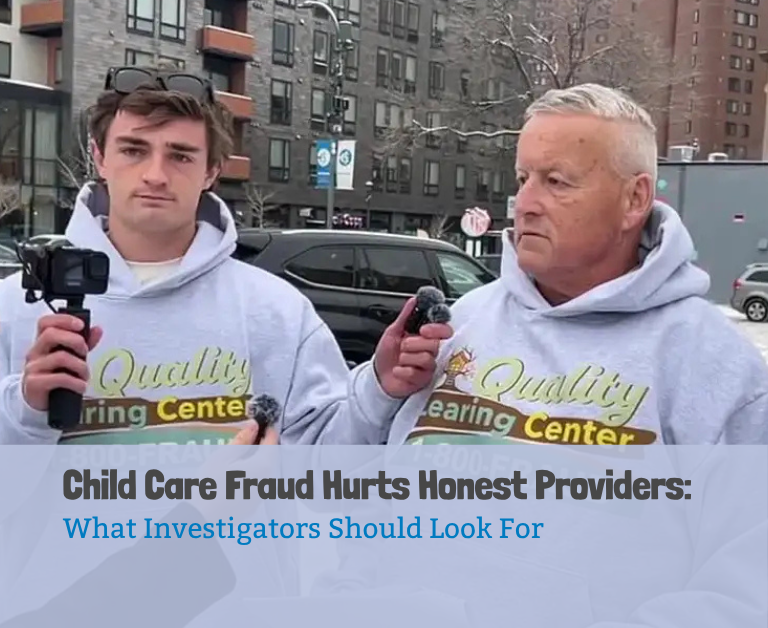
Public reporting around Minnesota childcare concerns has included allegations, closures, licensing issues, and investigations. CBS Minnesota reported that Quality Learning Center closed after being featured in Nick Shirley’s video, and that the center had received $1.9 million from Minnesota’s Child Care Assistance Program in fiscal year 2025. CBS also noted that state licensing records showed operational violations, while reported evidence of fraud had not been established at that time.
That distinction matters.
The point is not to weaken fraud investigations.
The point is to make them stronger.
Fraud should be proven with records, billing patterns, attendance, licensing data, financial information, and evidence — not assumptions alone.
The better the evidence, the harder it is for bad actors to hide.
How Child Care Biz Help Views This Issue
Child Care Biz Help supports honest childcare providers.
We also support accountability.
Fraud has no place in childcare. It steals from children, families, staff, taxpayers, and legitimate providers who are working hard to operate the right way.
Our industry becomes stronger when bad actors are exposed, systems are improved, and honest providers have the tools, training, and accountability needed to operate with integrity.
We believe the childcare industry needs both compassion and accountability.
Families need access to care.
Providers need sustainable business models.
Staff need fair wages.
Communities need more high-quality childcare options.
And taxpayers deserve to know that public funds are being used appropriately.
How Childcare Owners Can Build Stronger Systems
Many childcare problems begin with weak systems.
Even when there is no fraud, poor documentation can create risk. A center may be doing the right thing but still struggle to prove it if attendance records, billing systems, staff files, parent agreements, or subsidy documentation are incomplete.
Childcare owners should regularly review:
- Enrollment procedures
- Attendance tracking
- Billing and collections
- Subsidy reconciliation
- Parent agreements
- Staff records
- Payroll records
- Training documentation
- Licensing files
- Meal count records
- Safety policies
- Financial controls
- Director accountability
- Communication systems
Strong systems protect children, families, staff, owners, and the business.
They also make it easier to identify problems early.
Final Thought: Root Out Fraud and Protect Honest Providers
When fraud happens in childcare, children lose.
Families lose.
Taxpayers lose.
Staff lose.
Honest providers lose.
The entire industry loses.
The answer is not to ignore fraud. The answer is not to assume every provider is guilty. The answer is to expose bad actors, strengthen oversight, improve provider systems, and protect the honest childcare businesses that are serving families every day.
Child care fraud hurts everyone.
Rooting it out helps the entire industry become stronger.

Call to Action
If you operate a childcare center and want to strengthen your systems, billing practices, enrollment tracking, staffing documentation, policies, or operational procedures, Child Care Biz Help can help you build a stronger foundation.
We help childcare owners, churches, entrepreneurs, employers, and community leaders improve operations, strengthen systems, review compliance risks, and build sustainable childcare businesses.
Schedule a Childcare Operations Review
If you are unsure whether your childcare center’s systems, documentation, billing practices, staffing records, or operations are as strong as they should be, now is the time to review them. Child Care Biz Help can help you identify gaps, strengthen your processes, and build a more organized, accountable childcare business.
FAQ: Child Care Fraud and Honest Providers
About the Author
Caroline Jens is the Co-Founder of Child Care Biz Help and has nearly 20 years of experience in childcare leadership, operations, enrollment growth, staffing, and business strategy. Child Care Biz Help supports childcare owners, churches, entrepreneurs, employers, and community leaders with feasibility studies, startup planning, center operations, marketing, enrollment strategy, and sustainable growth.