
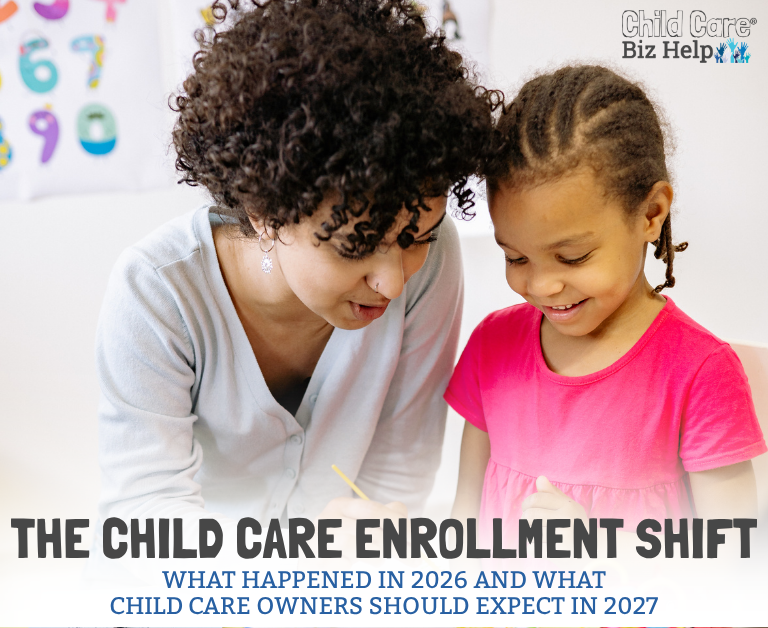
Child Care Enrollment Trends: What Changed in 2026 and What to Expect in 2027
Child Care Enrollment Trends: What Changed in 2026 and What to Expect in 2027
"Why has enrollment become so unpredictable?"
It’s one of the most common questions we’re hearing from child care owners across the country.
Child care enrollment trends in 2026 have become increasingly difficult to predict. Some centers continue to operate with waiting lists, while others are working harder than ever to fill classrooms.
Some owners have doubled down on marketing, invested in new websites, or increased advertising, yet inquiries remain flat. Others haven’t changed much at all and are experiencing record enrollment.
So, what’s going on?
Working with child care centers across the country, we’re seeing a significant shift in enrollment. While every market is different, one thing has become increasingly clear: today’s enrollment challenges aren’t being driven by a single issue.
They’re being shaped by changing demographics, evolving family expectations, new competition, advances in technology, and local market conditions that look very different than they did just a few years ago.
The encouraging news is that families still need exceptional child care. In many communities, demand continues to outpace supply.
The difference is that success today depends less on doing what worked five years ago and more on understanding what is happening in your local market right now.
As we move through the second half of 2026, several child care enrollment trends are becoming impossible to ignore. These trends will continue shaping enrollment through the remainder of this year and, in our opinion, will become even more important as we head into 2027.
Let’s take a closer look.
1. Child Care Demand Is Still Strong, But It's No Longer Evenly Distributed
One of the biggest misconceptions in our industry is that there is either "a child care shortage" or "an enrollment problem."
The reality is much more complex.
Across the United States, we've analyzed markets where providers have waiting lists extending months into the future. We've also worked with centers in communities where classrooms are sitting partially empty.
Both can exist at the same time.
That's because enrollment is no longer driven by national trends, it's driven by local market conditions.
A center located in a rapidly growing suburb may experience record enrollment, while another center just fifteen miles away struggles because young families have moved elsewhere, housing costs have changed, or new competitors have entered the market.
We've also seen situations where infant classrooms have extensive waiting lists while preschool classrooms remain under-enrolled. In other communities, the opposite is true.
The lesson?
Successful child care owners are no longer asking:
"Is there demand for child care?"
Instead, they're asking:
- Is my community growing?
- Where are young families moving?
- Which age groups have the greatest unmet demand?
- What does my competition actually look like?
- Are we offering the programs today's families need?
Those are very different questions—and they lead to much better decisions.
2. Parents Are Shopping for Child Care Differently Than Ever Before

Think about how you make important purchasing decisions today.
Whether you're buying a vehicle, choosing a vacation destination, hiring a contractor, or selecting a restaurant, chances are you spend time researching before making contact.
Parents do exactly the same thing.
Long before they schedule a tour, many families have already:
- Read your Google reviews.
- Compared your website with several competitors.
- Visited your Facebook and Instagram pages.
- Asked for recommendations in neighborhood Facebook groups.
- Looked at classroom photos.
- Compared tuition.
- Reviewed your curriculum.
- Read your policies.
- Visited your Google Business Profile.
- Decided whether your program feels like the right fit.
In many cases, parents have narrowed their choices to just two or three centers before they ever pick up the phone.
That means your first impression is no longer made when a family walks through your front door.
It's made online.
This is why investing in your website, online reviews, photography, messaging, and educational content is no longer optional.
- Parents are looking for confidence.
- They want reassurance that their child will be safe.
- They want to know your teachers are caring.
- They want evidence that your program prepares children for kindergarten.
- They want to feel like they'll be joining a community—not simply purchasing a service.
The centers that communicate these things well are earning trust before the first tour ever takes place.
3. Artificial Intelligence Is Already Changing How Families Find Child Care
 One of the biggest enrollment shifts we're watching isn't happening inside child care centers. It's happening on parents' phones and computers.
For years, families searched for child care by typing phrases like:
"Daycare near me."
"Best preschool in my city."
"Infant care near me."
Google returned a list of websites, and parents clicked through to compare their options.
Today, that process is changing.
More parents are turning to AI-powered tools like ChatGPT, Google's AI Overviews, Gemini, and Perplexity to ask much more detailed questions, such as:
- What's the best daycare near me for infants?
- Which preschool has the strongest kindergarten readiness program?
- What questions should I ask when touring a child care center?
- Which child care centers have the best parent reviews?
- What curriculum is best for my three-year-old?
Rather than simply displaying a list of websites, AI is beginning to summarize information, compare providers, and answer questions before parents ever visit a website.
That represents a significant shift.
Your website is no longer competing only for clicks.
It's competing to become a trusted source of information.
What Does This Mean for Child Care Centers?
It means families are rewarding expertise.
The child care centers that answer questions, educate parents, and consistently publish helpful information are becoming more visible, not only to parents, but also to the AI systems helping parents make decisions.
Think about it this way.
If your website only contains a homepage, tuition page, and contact form, AI has very little information to understand what makes your center unique.
But imagine your website also includes articles like:
- How to Know if Your Child Is Ready for Preschool
- What to Look for During a Child Care Tour
- Play-Based Learning vs. Academic Learning
- How Child Care Builds Kindergarten Readiness
- Tips for a Smooth First Day of Child Care
Now your website begins demonstrating expertise.
You're answering the exact questions families are already asking. That's incredibly valuable.
AI Won't Replace Relationships
 Some owners worry that AI will replace the personal relationship building that's so important in child care. We don't believe that's true.
Parents will always want to meet teachers. Walk through classrooms.
Watch children interact, experience the culture and trust their instincts. Those moments can't be replaced by technology.
However, AI is increasingly influencing which centers make it onto a parent's shortlist.
If families never discover your program because your online presence isn't strong enough, you may never get the opportunity to build those relationships.
That's why we believe every child care owner should start thinking beyond traditional marketing.
Ask yourself:
- Does my website answer parents' biggest questions?
- Am I creating helpful content that builds trust?
- Are my Google Business Profile and online listings accurate?
- Do my reviews reflect the quality of my program?
- Would someone who has never heard of us immediately understand what makes us different?
The child care centers that thrive in the years ahead won't simply have the biggest advertising budgets.
They'll have the strongest online authority and the clearest message.
And that's a very different strategy than simply spending more money on ads.
4. Your Competition Isn't Who You Think It Is
Ask most child care owners who their biggest competitor is, and they'll usually name another center down the road.
While that's certainly part of the picture, it's no longer the whole story.
Today's families have more early childhood options than ever before, and they're evaluating each one through a different lens.
Depending on your community, you may be competing with:
- Public preschool and Universal Pre-K programs
- Church-based early learning centers
- Montessori and Reggio Emilia schools
- Nature-based and outdoor learning programs
- Licensed family child care homes
- Nanny shares
- Employer-sponsored child care benefits
- Flexible care arrangements made possible by hybrid or remote work
The reality is that parents aren't simply asking, "Which child care center should I choose?"
They're asking, "What's the best option for my family?"
That's an important distinction.
Every family has different priorities. Some are focused on educational outcomes. Others need extended hours to accommodate work schedules. Some value faith-based programming, while others prioritize outdoor learning, language immersion, or smaller class sizes.
The centers that continue to grow are those that understand why families choose them and communicate that value clearly and consistently.
Quality is essential, but quality alone isn't enough if prospective families don't understand what makes your program different.
5. Marketing Alone Won't Solve an Enrollment Problem
 One of the first questions we often hear is:
"Should we spend more on marketing?"
Sometimes the answer is yes. But more often than not, our response is: "Let's figure out why enrollment has changed before we decide how to market."
Marketing is designed to amplify what's already working. If the underlying strategy isn't aligned with your market, additional marketing often produces disappointing results.
Think about it this way.
If your center has limited infant capacity in a community where infant care is in the highest demand, no amount of Facebook advertising is going to solve that mismatch.
If your hours don't meet the needs of today's working families, Google Ads won't fix it.
If your website doesn't build trust, increasing website traffic won't necessarily lead to more enrollments.
We've seen owners spend thousands of dollars trying to market their way out of challenges that were actually caused by something else:
- A classroom mix that no longer reflects local demand.
- Tuition that isn't positioned appropriately for the market.
- A weak tour process.
- Slow response times to new inquiries.
- Changing neighborhood demographics.
- New competition entering the community.
- A website that doesn't effectively communicate the value of the program.
Marketing matters. But it works best when it’s built on a strong business strategy. That’s why we encourage owners to diagnose the problem before prescribing the solution. Our child care business consulting services help established center owners identify the underlying causes of enrollment challenges and create a practical strategy for sustainable growth.
6. Market Intelligence Is Becoming the New Competitive Advantage
 If there's one trend we believe will separate thriving child care businesses from struggling ones over the next several years, it's this:
The best decisions will be driven by market intelligence, not assumptions.
For many years, major business decisions were often based on instinct.
- Owners expanded because they felt the market was growing.
- They added classrooms because they assumed demand was there.
- They increased marketing because enrollment slowed.
Sometimes those decisions worked but sometimes they became expensive lessons.
Today's most successful owners are taking a different approach.
Before investing significant time and money, they're asking questions like:
- Is my community growing or shrinking?
- Where are young families moving?
- Which age groups have the greatest unmet demand?
- What programs are parents actively looking for?
- What are competitors doing well?
- Are there underserved neighborhoods nearby?
- Does it make sense to expand, or should we optimize what we already have?
Those answers create confidence. Instead of reacting to enrollment changes, owners can anticipate them.
That shift, from reactive to proactive, is one of the biggest differences we're seeing among high-performing child care businesses.
Feasibility Studies Aren't Just for Startups Anymore
When many people hear the words childcare feasibility study, they immediately think about someone opening their very first child care center.
While feasibility studies are an essential step for startups, that's no longer the only time they're valuable.
Increasingly, we're seeing established child care businesses use market analysis to answer questions like:
- Should we expand to a second location?
- Should we add another infant classroom?
- Are we serving the right age groups?
- Has our community changed?
- Why has enrollment slowed?
- Are we investing in the right opportunities?
These aren't marketing questions. They're business strategy questions. And they're often best answered with data rather than assumptions.
Understanding population growth, birth trends, household demographics, tuition rates, competitive supply, employer growth, and future development plans provides a level of clarity that simply isn't possible through intuition alone.
The goal isn't to eliminate risk. The goal is to make smarter decisions with the best information available.
7. What Child Care Owners Should Expect in 2027
 While no one can predict the future with complete certainty, several trends are already pointing to where the industry is headed.
We believe 2027 will continue rewarding child care businesses that are willing to adapt rather than simply react.
Here's what we expect to continue shaping enrollment:
Parents Will Expect More Transparency
- Families want information before they ever schedule a tour.
- They expect pricing information, educational philosophy, classroom photos, teacher credentials, safety practices, and clear communication to be easy to find.
- The easier you make it for parents to learn about your program, the more confidence they'll have in reaching out.
Technology Will Continue Changing How Families Search
- Artificial intelligence isn't replacing relationships. It's changing how relationships begin.
- Families will continue relying on AI-powered search, online reviews, local recommendations, and educational content to narrow their options.
- The centers that consistently publish helpful information and maintain a strong online presence will have a significant advantage.
Reputation Will Matter More Than Advertising
- Trust has always mattered.
- Now it's measurable.
- Your reviews.
- Your response time.
- Your website.
- Your social media.
- Your community involvement.
- Your online authority.
Together, these create your reputation long before a family walks through your front door.
Advertising can introduce your center but reputation is what earns a tour.
Data Will Drive Better Business Decisions
- Perhaps the biggest shift we'll continue to see is that successful owners will rely less on guesswork and more on information.
- Understanding local demographics, enrollment trends, competition, and community growth won't just be helpful—it will become essential.
- The centers that understand their markets best will be in the strongest position to adapt as those markets continue to evolve.
Our Advice for the Rest of 2026
Before increasing your advertising budget...
Before launching another enrollment campaign...
Before adding classrooms...
Before expanding to a second location...
Take a step back and ask yourself a few important questions.
- Do I truly understand my market today?
- Have the demographics around my center changed?
- What are families looking for that we aren't offering?
- Why are families choosing us?
- Why are some choosing someone else?
- Am I solving the right problem?
Sometimes enrollment challenges really are marketing issues.
Sometimes they're operational.
Sometimes they're demographic.
Sometimes they're strategic.
The first step toward sustainable growth is identifying which challenge you're actually facing.
Looking Ahead
 The child care industry isn't shrinking. It's changing.
Families continue to value high-quality early childhood education. Communities continue to need exceptional child care providers. And the opportunities for growth remain significant.
The owners who thrive in 2027 won't necessarily be the ones with the largest buildings or the biggest advertising budgets.
- They'll be the ones who understand their communities.
- Who invest in relationships.
- Who embrace new technology without losing the personal touch that makes child care so meaningful.
- Who build trust before asking for enrollment.
- And who make business decisions based on data instead of assumptions.
At Child Care Biz Help, we've had the privilege of working alongside child care owners in communities across the country. While every market is unique, one lesson continues to prove true: the most successful businesses aren't simply reacting to change, they're preparing for it.
The future of enrollment doesn't belong to those who guess.
It belongs to those who understand their market, adapt with confidence, and lead with intention.
Are You Ready to Make More Confident Enrollment Decisions?
 If your enrollment has become unpredictable, increasing your advertising budget may not be the first step. Before investing more money, adding classrooms, changing tuition, or expanding into a new market, you need to understand what is actually happening in your community.
Child Care Biz Help works with child care owners across the country to evaluate enrollment challenges, uncover market opportunities, strengthen business strategy, and create a clear path forward.
Let’s talk about what you’re experiencing and determine the right next step for your child care business.